Tips to Prepare Trees for a Storm to Prevent Damage
February 6, 2026
Storms can roll through Bucks County in what feels like the blink of an eye. One minute, it’s calm, and the next, you’re hearing thunder, seeing the sky turn dark, and getting alerts about high wind warnings. And honestly? Most homeowners don’t think about their trees until they hear those warnings or see lightning in the forecast.
The good news is that while you can’t control the weather, you can reduce the chance of broken limbs, uprooted trees, and expensive property damage by taking a few proactive steps ahead of time. In fact, a little storm preparation goes a long way when it comes to keeping your trees healthier and your home safer.
Below, our ISA-certified arborists at All The Above Tree Service will walk you through the most effective ways to prepare your trees for the next big storm.
Why Storm Prep Matters for Tree Safety in Bucks County
Bucks County gets a mix of weather that can be rough on trees, including heavy spring rains, summer thunderstorms, high winds, and even winter storms that pile on snow and ice. And while healthy trees are surprisingly strong, many trees in residential neighborhoods have hidden weak points that don’t show up until a storm puts them to the test.
When you prepare your trees for upcoming storms, you help to avoid:
- Large branches crashing onto your roof, driveway, or vehicles
- Trees uprooting and falling across fences or into neighboring yards
- Limbs taking down power lines
- Emergency tree situations that cost far more than routine maintenance
In short, preventative care gives your trees a better chance of surviving severe weather with minimal damage.
Steps for Preparing Your Trees for Upcoming Storms
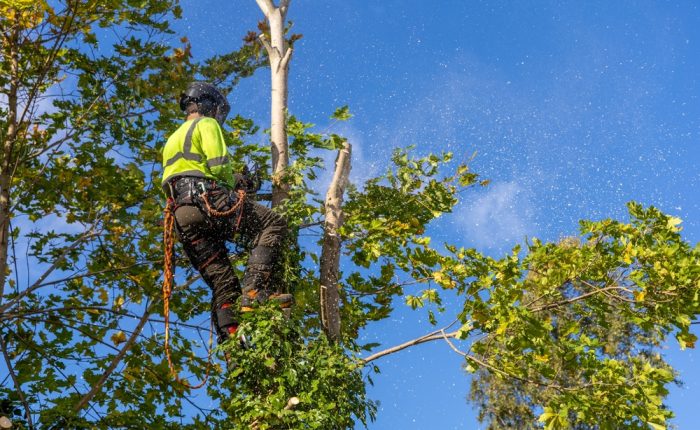
Trim Weak, Dead, or Overextended Limbs Before They Break
One of the most effective ways to prepare trees for a storm is also one of the simplest: remove what’s most likely to fail.
Dead branches are the biggest red flag. They’re brittle, they don’t flex in the wind, and they can break off even during mild storms. During severe weather, deadwood becomes airborne debris — and that’s when damage happens fast.
Overextended limbs are another common issue that should be addressed before an impending storm. If a limb is stretching far out over your driveway, roof, shed, or fence line, it’s carrying extra weight. And wind can catch that limb like a sail, and the branch will become far more likely to crack.
A professional tree pruning service can:
- Remove deadwood before it becomes a hazard
- Reduce end-weight on long limbs
- Improve canopy balance so wind moves through instead of fighting against it
- Address weak branch unions (where splitting often begins)
One important note: storm prep pruning is not the same as “topping” a tree. Topping creates unstable regrowth and actually makes trees more dangerous over time. Proper pruning should be strategic and focused on structure, health, and long-term stability.
Watch for Trees That Are Already Under Stress
Trees don’t need to be dead to be dangerous. In fact, many storm failures happen because a tree was already stressed — and the storm was simply the final push.
In Bucks County, stress can come from:
- Drought conditions in late summer
- Excessive rainfall that weakens roots
- Insect infestations
- Fungal diseases
- Construction damage or soil compaction
- Age-related decline
A stressed tree often has less energy to maintain strong wood, defend itself from decay, and keep its roots anchored firmly in the soil. That means branches may snap more easily, and the entire tree may be more likely to uproot.
So, as you prepare for the next big storm, keep an eye out for these common signs your tree is under stress:
- Thinning canopy or sparse leaves
- Leaf discoloration in the growing season
- Dead branches appearing throughout the crown
- Peeling bark or cracks in the trunk
- Mushrooms or fungal growth near the base of the tree
- Unusual leaning that wasn’t there before
If you notice any of these issues, it’s worth scheduling an inspection. A tree doesn’t have to fall to cause a major problem — even one large limb can total a vehicle or destroy a section of fence.
Don’t Ignore Root Zone Issues
Most homeowners focus on what they can see — the trunk, the branches, the canopy. But when it comes to storm safety, the root zone is often the most important part of the entire tree. This is because a tree with a beautiful canopy can still fail if the roots are compromised.
Root issues are especially common after long rainy periods. Saturated soil becomes loose, and trees with shallow roots or damaged root systems are more likely to uproot in high winds.
One of the easiest storm-prep steps homeowners can take is improving the base area of the tree:
- Keep mulch in a flat ring, not piled against the trunk.
- Avoid parking or storing heavy equipment over the roots.
- Don’t dig or trench near mature trees without professional guidance.
- Watch for signs of heaving soil or lifting roots.
If you see the ground lifting around the base of a tree after wind, that’s a serious warning sign that the tree may already be partially uprooting.
What to Do if You’re Not Sure Your Tree Is Safe
Many homeowners look at a tree and think, “It seems fine… but I’m not totally sure.” And that’s completely normal. Tree hazards aren’t always obvious, especially if the decay is internal or the weak point is high up in the canopy.
If you’re unsure, the safest and smartest move is to schedule a professional assessment with an ISA-certified arborist. An arborist can evaluate things like:
- Structural balance
- Branch attachment strength
- Signs of internal decay
- Root stability and soil conditions
- Previous storm damage
- Disease or insect stress
A professional tree inspection is also helpful because it gives you a clear plan. Instead of guessing, you’ll know whether the tree needs pruning, support, treatment, monitoring, or removal.
And if you have multiple mature trees on your property (especially near your house or driveway), storm prep inspections are one of the best investments you can make.
After the Storm: Signs Your Tree May Still Be Dangerous
Sometimes, the storm passes, and everything looks okay, but hidden damage may still be present. That’s why it’s important to walk your property once it’s safe to do so and check for warning signs.
After a storm, watch for:
- Hanging branches caught in the canopy (“widowmakers”)
- Large cracks in the limbs or the trunk
- Splits where major branches connect
- Bark peeling away in long strips
- New leaning or tilting
- Soil lifting or cracking around the base
- Broken tops or missing sections of the canopy
Also, pay attention to trees near power lines. If a limb is tangled in wires or a tree is leaning toward utility lines, do not try to handle it yourself. That’s a situation for professionals.
Get Ahead of the Next Storm With Professional Tree Care
Storms are part of life in Bucks County, but tree damage doesn’t have to be. With proactive pruning, root zone awareness, and a professional eye on tree health, you can dramatically reduce the chances of broken limbs, uprooted trees, and costly property damage.
All The Above Tree Service helps homeowners throughout Bucks County, PA, prepare their trees before storms through professional inspections, pruning, and hazard prevention. If you want peace of mind before the next big storm rolls in, our ISA-certified arborists are ready to help you protect what matters most — your home, driveway, vehicles, fences, and neighboring properties.
Reach out today to schedule a tree safety inspection and take the stress out of storm season. And don’t forget that we’re also here to help with storm-damage cleanup!